
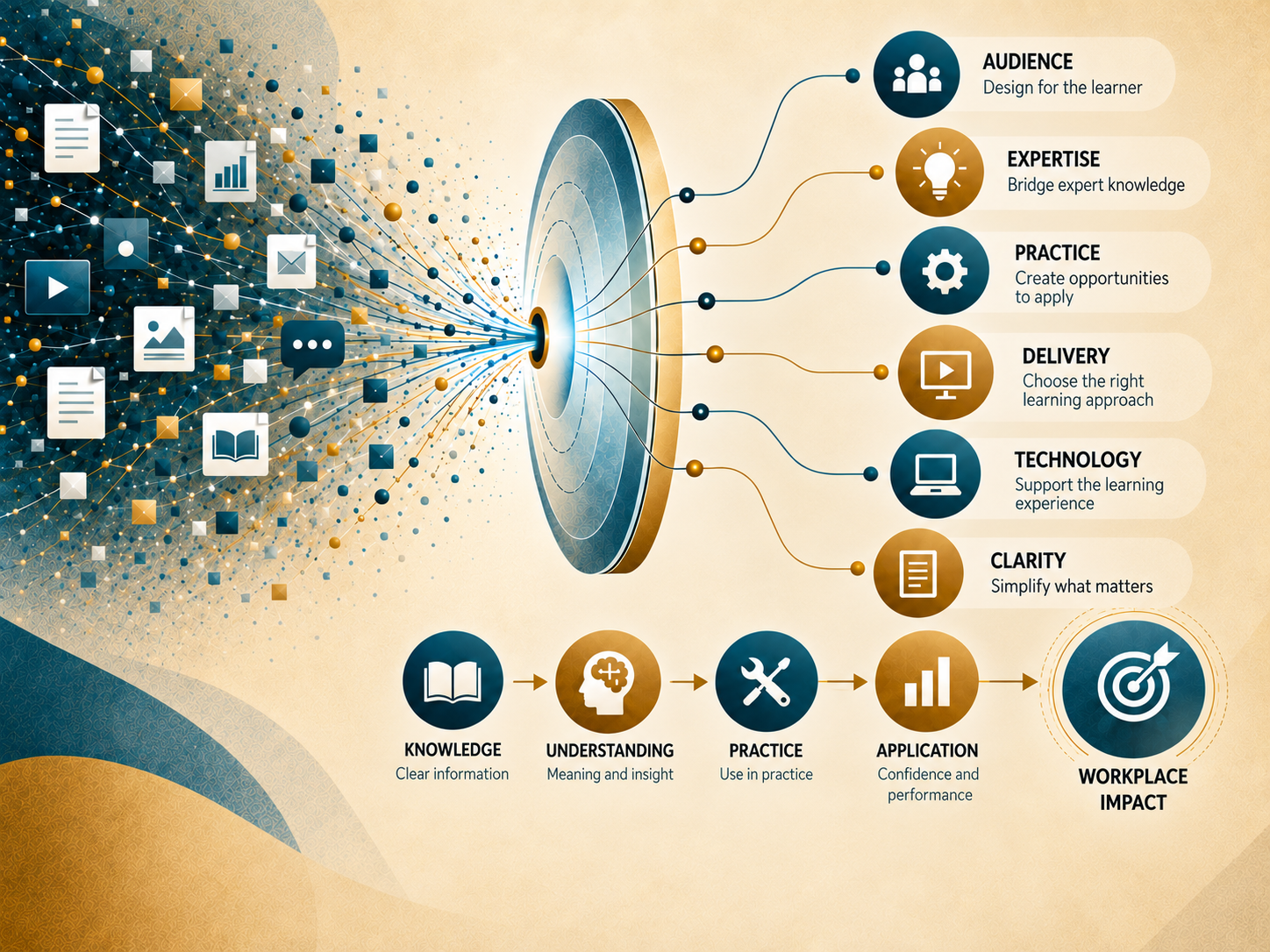
From Content to Learning: Where Learning Design Makes the Difference
Organisations rarely begin a learning project with nothing. More often, they already have plenty of content.
There may be a new policy to understand, a product range employees need to know, a customer-service approach to introduce, or an operational process that has changed. Subject-matter experts may have prepared detailed information, presentations may already exist, and supporting documents may run to dozens — sometimes hundreds — of pages. It is tempting to think that most of the work has therefore been done: we have the content; now we simply need to train people on it.
But content and learning are not the same thing. Decades of research into how people learn, point to the same distinction: learning depends not simply on access to information, but on how new knowledge connects with what people already know, how it is structured and experienced, and whether learners have opportunities to apply it.1
Information may be accurate, comprehensive and professionally presented without necessarily helping someone understand what matters most, remember it, or apply it effectively. The challenge is to decide what people genuinely need to know, what they need to be able to do differently as a result, and how the available content can be shaped into a learning experience that helps them get there.This is where learning design begins.
Content and learning are not the same thing
Content asks: What information do we have? What needs to be shared?
Learning design asks a different set of questions.
What does the audience actually need to understand? What should they be able to do differently afterwards? What prior knowledge can we assume? What information is essential, and what may add unnecessary complexity? In what sequence should ideas be introduced? And where do people need opportunities to practise, reflect, discuss or apply what they are learning? These questions change the nature of the work.
A detailed policy document may contain everything an employee needs to know from an organisational perspective, but it is unlikely to be an effective learning experience in its original form. The same applies to product specifications, technical documentation, process manuals or slides prepared by a subject-matter expert. All may be valuable source material, but none automatically tells us how best to help someone learn.
Learning design therefore involves deliberate choices about what to include, what to leave out, how to structure the material and how to connect it to the learner’s real working environment.The goal is not simply to make information easier to read. It is to shape content so that it supports understanding, retention and, ultimately, useful action.
The challenge of expert knowledge
Subject-matter experts are essential to good learning. They hold the knowledge, experience and technical understanding the learning ultimately needs to convey. But expertise can also create an unexpected challenge.
The more familiar someone becomes with a subject, the harder it can be to judge what a novice will find difficult or what background knowledge they may be missing. Concepts that seem obvious to an expert may be unfamiliar to a learner. Specialist language may feel natural, while important background knowledge may be assumed rather than explained. Experts may also understandably want to include far more information than a learner needs at that point.
Researchers sometimes describe this as the “expert blind spot”: expertise can make it more difficult to judge what a novice already understands, what they are likely to find difficult and which intermediate steps still need to be made explicit.2 This is not a weakness in subject-matter expertise. It is simply a different perspective.
Learning design helps bridge the gap between what an expert knows and what a learner needs. That may involve asking seemingly simple questions: What does this person really need to know to perform their role? What do they need first, and what can come later? Which examples will make the concept meaningful? Where could misunderstanding occur? What terminology needs to be explained or simplified? Often, one of the most valuable parts of the process is not creating new information at all. It is working carefully with existing expertise, identifying what matters most, and shaping it into a form another person can genuinely understand and use.
The expert provides the depth. Learning design helps create the bridge.
Moving from information to application
Understanding something in principle is not always the same as being able to apply it in practice.
Learning researchers often describe this as the challenge of “transfer”: whether knowledge and skills acquired through learning can be carried into the workplace and used effectively in real situations.3 An employee may understand a customer-service principle in a classroom or presentation, but applying it can look very different when a customer is frustrated, a queue is growing, a product is unavailable, or several demands are competing for attention.
The same applies elsewhere in workplace learning. Someone may know the steps in a process, recognise the wording of a policy or remember product features, yet still struggle when they need to make a judgement, adapt to a situation or use that knowledge under pressure. This is why effective learning often needs to go beyond explanation.
People may need opportunities to work through realistic scenarios, make decisions, discuss possible responses, practise a skill, receive feedback or reflect on how a principle applies in their own role. These activities help move learning from something that is simply understood towards something that can actually be used.4 Good learning design therefore keeps asking: What will the learner need to do with this information?
Instead of focusing only on what should be presented, it focuses on what needs to be practised, experienced or applied. Ultimately, the value of workplace learning is not measured by how much information was covered, but by whether people are better equipped to act on what they have learned.
Designing for the people who actually have to learn
The same content will not necessarily work equally well for every audience. A new employee, an experienced manager, a frontline team member and a technical specialist may all need to understand the same broad topic, but they bring different levels of knowledge, responsibility and experience. Their working environments may also be very different.
Effective learning design takes those differences seriously. It considers what learners already know, what they need to know next, how much time they realistically have, what language and terminology will be most accessible, and how the learning will fit into the context in which they work.5
This matters particularly in organisations with diverse workforces. A learning solution may need to work across different roles, levels of education, language backgrounds, geographic locations or operational settings. What makes sense in a quiet training room may not translate easily to a busy store, production environment or fast-moving service setting.
Designing for the learner therefore means making choices about more than content. It may affect the length of the learning, the examples used, the amount of explanation required, the balance between theory and practice, and the way the learning is delivered.
The aim is not to oversimplify. It is to make the learning appropriately clear, relevant and usable for the people who need it.Instead of asking only, What do we need to tell people? we also need to ask, What will help these particular people learn?
Choosing the right learning approach
An important part of learning design is deciding not only what people need to learn, but how that learning should take place.
There is no single delivery method that is right for every learning need.6 Some subjects benefit from face-to-face facilitation, particularly where discussion, practice, coaching or immediate feedback are important. Others may work well through a live virtual environment such as Microsoft Teams, especially where employees are geographically dispersed.
Some learning can be completed independently through self-study, digital modules, videos, guided reading or other resources that learners can access when needed. Other topics may require practical demonstrations, facilitated workshops, workplace activities or reinforcement after the initial learning. The choice should be driven first by the nature of the learning.
If employees need to practise a conversation, develop interpersonal skills or work through complex scenarios, interaction may be essential. If the objective is to introduce straightforward knowledge, refresh existing understanding or provide information people need to access repeatedly, a self-directed digital resource may be more appropriate.
But the organisation’s own environment matters too. A learning approach must take account of technological capability, infrastructure, devices, connectivity, learning platforms, facilitator capacity, operational realities and the amount of time employees can realistically spend away from their normal work.
A theoretically ideal solution is of little value if the organisation cannot practically support it. For this reason, a blended learning approach can be particularly valuable in workplace learning, allowing different methods to be combined according to the learning need and the organisation’s context.7
A programme might introduce concepts through digital self-study, use a facilitated face-to-face or Microsoft Teams session to explore and practise them, and then provide short digital resources or workplace activities to reinforce the learning afterwards. The blend will differ from one organisation to another. What matters is that the method follows the learning need rather than the other way around.
Technology as part of the learning experience
Technology has become an important part of how workplace learning is designed and delivered. Digital technology should not be used simply because it is available or because an organisation wants training to appear modern. Used poorly, it can add complexity without improving learning.
Used well, however, technology can extend the reach and flexibility of a learning solution while creating new opportunities for learners to access, engage with and revisit learning. Digital tools can make learning available across locations, provide resources at the point of need, support self-paced learning, enable virtual facilitation and reinforce learning after formal training. They can help create a learning journey that continues beyond a single workshop or event.
In today’s workplace, digital enablement is therefore an important consideration in learning design. This may range from videos, digital job aids, online resources or Microsoft Teams sessions through to more structured e-learning, learning management systems or integrated digital learning journeys.
The important question is not simply, What technology can we use?
It is: What role can technology play in helping these learners understand, practise, access and apply what they need to know?
The technology should support the learning — not dictate it.8
Why simplicity often requires more work
Good learning often looks simple when it is finished. The explanation is clear. The sequence feels logical. The examples make sense. Learners can see what matters and how it connects to their work.
But that simplicity is usually the result of careful design rather than less effort. Research into cognitive load and multimedia learning has long highlighted the limits of working memory when people are dealing with unfamiliar information. The design challenge is therefore not simply to reduce information, but to manage complexity so that learners can focus on what matters.9
Behind a well-structured learning experience are decisions about what to include, what to remove, what to explain first, which examples will make an idea clearer, where learners may become confused and how much detail is genuinely useful. There are also decisions about what should be facilitated, what can be self-directed, where technology adds value and where interaction matters.
Sometimes the hardest part of the work is deciding what not to say.
Subject-matter experts may understandably want to preserve every important detail. Organisations may want to ensure that nothing is omitted. Yet too much information can make learning harder rather than better, particularly when learners are expected to remember and apply the material in a busy working environment. Learning design therefore involves a constant process of prioritising, clarifying and sequencing without losing what is essential. That may mean breaking a complex concept into smaller parts, rewriting specialist language, reducing repetition, choosing one strong example instead of several weaker ones, moving detail into supporting material, or selecting different delivery methods for different parts of the learning.
The result should feel straightforward to the learner, even when the thinking behind it has been anything but simple.In that sense, clarity is not the absence of complexity. It is the outcome of working carefully with complexity until the learner no longer has to carry all of it.
Where learning design adds value
Learning design becomes especially valuable when an organisation needs people to move beyond simply receiving information.
This may happen when a product or service is introduced, a process changes, employees need to improve customer interactions, leaders are expected to adopt new behaviours, or complex technical or policy information needs to be understood and applied consistently. In each case, the organisation may already have the necessary knowledge. The challenge is turning that knowledge into something that helps people perform.
That is the point at which learning design adds structure.
It helps clarify the purpose, identify the audience, determine what really matters, sequence the content, choose appropriate examples and activities, and decide how learners will practise or apply what they are learning. It also helps determine the most appropriate learning approach: what should happen face to face, what might work virtually, what can be completed independently, where technology can support the experience, and how those elements can be combined into a practical solution the organisation can sustain. The value lies not simply in producing a workbook, presentation, facilitator guide or online module. Those are outputs. The more important contribution is the thinking that connects the organisation’s knowledge to the learner’s real-world needs — and creates the right learning experience around it.
A useful way of thinking about that progression is:
knowledge → understanding → practice → application10
That progression may take place across more than one learning environment or delivery method. When it is missing, organisations can invest significant time and resources in training that communicates a great deal but changes very little. When learning is designed well, it becomes more purposeful. People understand not only what they need to know, but why it matters and how to use it. That is where learning design earns its place: in helping organisations turn valuable content into learning that can make a practical difference.
Content is the raw material
Good content matters. Without accurate information, sound expertise and a clear understanding of what the organisation is trying to achieve, there is nothing meaningful to build from.
But content is the raw material, not the finished learning experience.
The real work lies in shaping that content around people, purpose and application: deciding what matters most, structuring it for understanding, creating opportunities to practise and apply it, and choosing learning methods and technologies that fit both the learner and the organisation. Effective learning is rarely achieved simply by transferring information from a document into a slide deck, workbook or online module — or by assuming that everything belongs either in a classroom or online.
Good learning design finds the right balance between the content, the learner, the workplace and the organisation’s capabilities — using different learning methods where they genuinely add value. When learning is designed well, people are not merely exposed to more information. They are better equipped to understand it, remember what matters and use it with confidence.
And that is ultimately the difference learning design makes: it turns content into something people can learn from — and act on.
Sources and Notes
- National Academies of Sciences, Engineering, and Medicine. (2018). How People Learn II: Learners, Contexts, and Cultures. Washington, DC: The National Academies Press. https://doi.org/10.17226/24783. See also Merrill, M. D. (2002). First principles of instruction. Educational Technology Research and Development, 50, 43–59. https://doi.org/10.1007/BF02505024. ↩︎
- Nathan, M. J., & Petrosino, A. (2003). Expert blind spot among preservice teachers. American Educational Research Journal, 40(4), 905–928. https://doi.org/10.3102/00028312040004905. See also Hinds, P. J. (1999). The curse of expertise: The effects of expertise and debiasing methods on predictions of novice performance. Journal of Experimental Psychology: Applied, 5(2), 205–221. https://doi.org/10.1037/1076-898X.5.2.205. ↩︎
- Baldwin, T. T., & Ford, J. K. (1988). Transfer of training: A review and directions for future research. Personnel Psychology, 41(1), 63–105. https://doi.org/10.1111/j.1744-6570.1988.tb00632.x. See also Blume, B. D., Ford, J. K., Baldwin, T. T., & Huang, J. L. (2010). Transfer of training: A meta-analytic review. Journal of Management, 36(4), 1065–1105. https://doi.org/10.1177/0149206309352880. ↩︎
- Roediger, H. L. III, & Karpicke, J. D. (2006). Test-enhanced learning: Taking memory tests improves long-term retention. Psychological Science, 17(3), 249–255. https://doi.org/10.1111/j.1467-9280.2006.01693.x. See also Hattie, J., & Timperley, H. (2007). The power of feedback. Review of Educational Research, 77(1), 81–112. https://doi.org/10.3102/003465430298487. ↩︎
- National Academies of Sciences, Engineering, and Medicine. (2018). How People Learn II: Learners, Contexts, and Cultures. Washington, DC: The National Academies Press. https://doi.org/10.17226/24783. See also Simonsmeier, B. A., Flaig, M., Deiglmayr, A., Schalk, L., & Schneider, M. (2022). Domain-specific prior knowledge and learning: A meta-analysis. Educational Psychologist, 57(1), 31–54. https://doi.org/10.1080/00461520.2021.1939700. ↩︎
- Sitzmann, T., Kraiger, K., Stewart, D., & Wisher, R. (2006). The comparative effectiveness of web-based and classroom instruction: A meta-analysis. Personnel Psychology, 59(3), 623–664. https://doi.org/10.1111/j.1744-6570.2006.00049.x. ↩︎
- Means, B., Toyama, Y., Murphy, R., Bakia, M., & Jones, K. (2010). Evaluation of Evidence-Based Practices in Online Learning: A Meta-Analysis and Review of Online Learning Studies. U.S. Department of Education. The review found modest overall advantages for online conditions and larger effects in blended conditions, while cautioning that blended conditions often included additional instructional elements and learning time. Source ↩︎
- Yu, W., He, J., & Gong, Y. (2023). A systematic review of information technology in workplace learning. Psychology in the Schools, 60(12), 4904–4929. https://doi.org/10.1002/pits.22901. See also Mayer, R. E. (2017). Using multimedia for e-learning. Journal of Computer Assisted Learning, 33(5), 403–423. https://doi.org/10.1111/jcal.12197; and UNESCO. (2023). Global Education Monitoring Report 2023: Technology in education – A tool on whose terms? Paris: UNESCO. https://doi.org/10.54676/UZQV8501. ↩︎
- Sweller, J., van Merriënboer, J. J. G., & Paas, F. (2019). Cognitive architecture and instructional design: 20 years later. Educational Psychology Review, 31, 261–292. https://doi.org/10.1007/s10648-019-09465-5. See also Mayer, R. E. (2017). Using multimedia for e-learning. Journal of Computer Assisted Learning, 33(5), 403–423. https://doi.org/10.1111/jcal.12197. ↩︎
- The sequence ‘knowledge → understanding → practice → application’ is used here as a practical Content Strategics framing rather than as a formal published four-stage model. It is broadly consistent with Merrill’s emphasis on activation, demonstration, application and integration: Merrill, M. D. (2002). First principles of instruction. Educational Technology Research and Development, 50, 43–59. https://doi.org/10.1007/BF02505024. ↩︎