When AI Makes the Work Easier, What Becomes More Valuable?
Something significant is happening to the cost of getting knowledge work done.
Tasks that once required hours of searching, drafting, summarising, comparing, reorganising or starting again can increasingly be completed—or at least brought to a useful first draft—in minutes. Artificial intelligence is not eliminating the need for human work, but it is changing where much of that work begins and where human effort is best spent.
The pace of adoption illustrates the scale of the change. Stanford University’s 2026 AI Index reports that 88% of surveyed organisations were using AI in 2025, while generative AI was being used in at least one business function by 70%. Yet widespread adoption does not mean that organisations have worked out how to use it well. 1
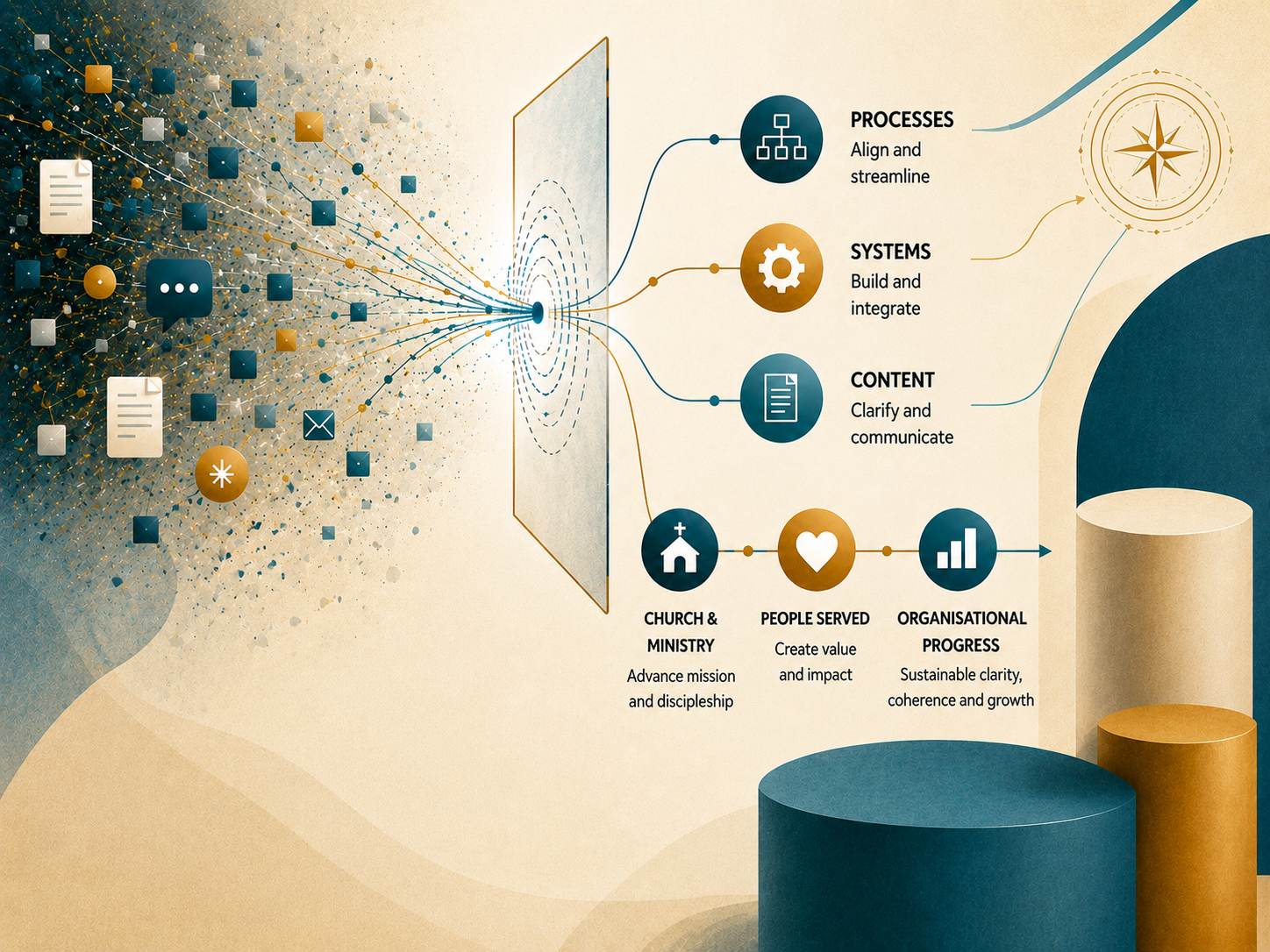
For an SME or mission-led organisation—a non-profit, church, denomination, public benefit organisation, or private higher education or theological training institution—that presents an intriguing opportunity. These organisations rarely have unlimited capacity. If technology can remove repetitive effort from research, administration, communication, content development and analysis, scarce human capacity can potentially be redirected towards work that matters more.
But potentially is an important word.
Having access to powerful tools is not the same as knowing where to use them, which experiments are worth pursuing, what should remain distinctly human, or when greater speed is simply enabling an organisation to produce more of the wrong thing.
Nobody working seriously in this field can credibly claim that all of those questions have already been answered. The technology is evolving too quickly for that. The more useful posture is one of informed curiosity: learning, testing, evaluating and adapting as the landscape changes.
Perhaps, then, the more interesting question is not simply what AI will enable us to do more easily. It is what becomes more valuable when doing becomes easier?
When production becomes easier, judgement becomes scarcer
When the effort required to produce something falls, the temptation is simply to produce more: more reports, communications, ideas, policies and content. But greater output does not automatically produce greater value.
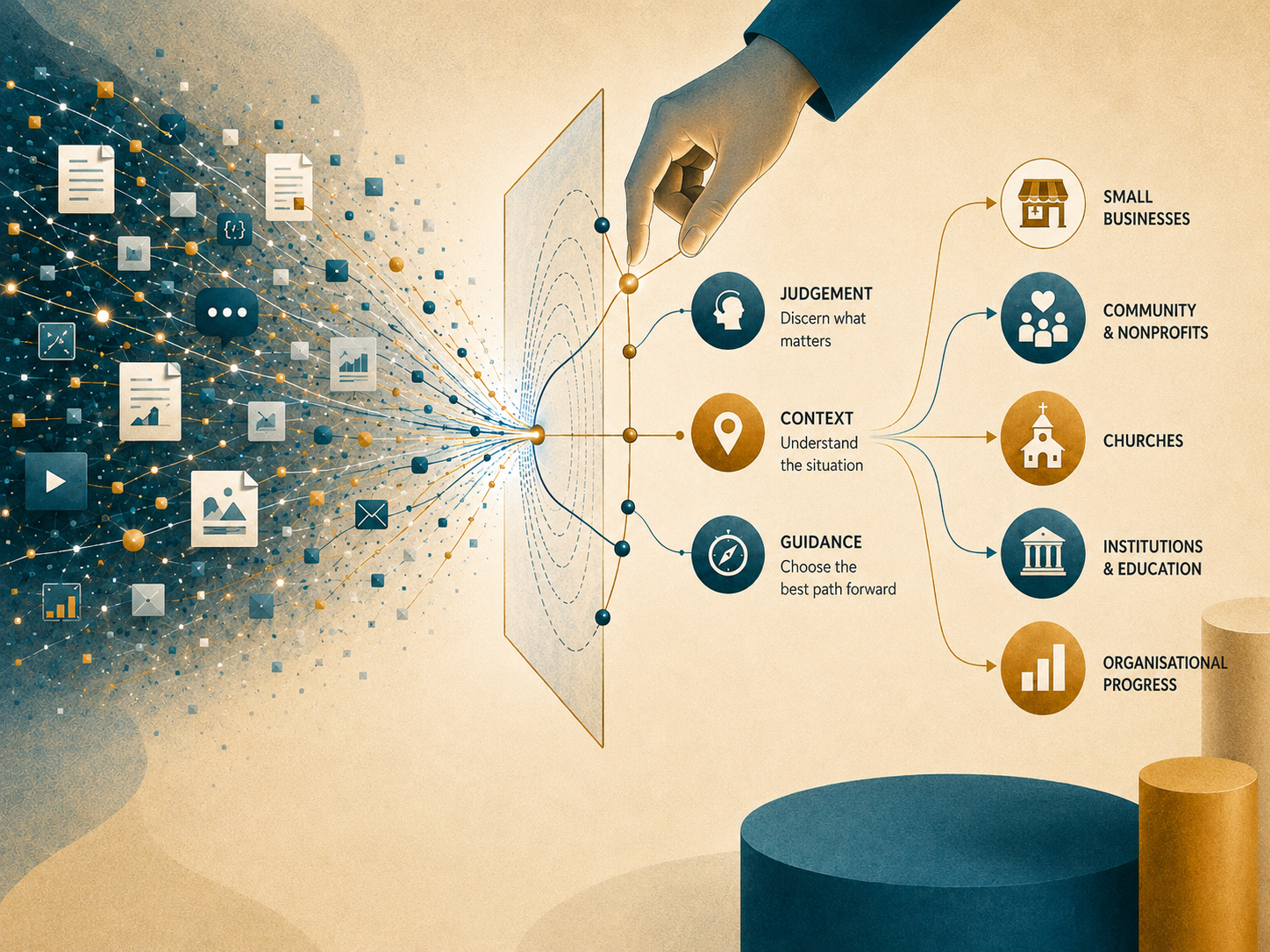
AI can generate options remarkably quickly; it cannot remove the need to decide which option deserves attention. Someone still has to understand context, weigh priorities, recognise what does not fit and decide whether an apparently efficient solution serves the organisation’s purpose.
That shifts the pressure point. The constraint is increasingly less about our ability to generate material and more about our ability to exercise judgement over what we generate.
For smaller and mission-led organisations, this matters especially. Limited capacity makes poor choices expensive—not only financially, but in wasted time, distracted people and initiatives that consume energy without advancing what the organisation exists to achieve.
Why this matters for smaller organisations
Large organisations can absorb a certain amount of experimentation. Smaller organisations usually cannot.
The same people are often responsible for operations, communication, administration, planning and delivery. A new tool or process that looks promising may therefore compete directly with work that already matters.
This makes AI adoption less about chasing the newest capability and more about choosing carefully where it genuinely helps. The OECD’s 2026 D4SME survey found that strategic, targeted and secure AI integration among SMEs remains uneven, while time constraints and skills gaps continue to hinder effective implementation. 2
A useful experiment can save hours or free someone for higher-value work. A poor one can create duplication, confusion or another system nobody has time to maintain.
The advantage lies not in using AI everywhere, but in identifying the few places where it meaningfully strengthens the organisation’s work.
The human work that becomes more valuable
As AI becomes better at producing, sorting and reshaping information, the distinctly human contribution moves further upstream.
It lies in understanding context, asking better questions, recognising nuance and deciding what matters most. It also lies in knowing when an apparently efficient answer is unsuitable, incomplete or simply wrong.
For smaller organisations, that human layer includes guided experimentation. New tools and approaches need to be tested against real needs, not adopted simply because they are available.
That is where thoughtful external support can add value—not by claiming certainty in a fast-changing field, but by bringing continuity, perspective and disciplined learning to the process. The aim is to help an organisation experiment more intentionally, learn more quickly and reduce the cost of avoidable missteps.
Moving forward without having to figure it all out alone
For many smaller organisations, the greatest risk is not failing to adopt AI quickly enough. It is adopting it without enough structure.
Experimentation will remain necessary because the tools, capabilities and expectations are still changing. But experimentation does not have to be random. With the right guidance, organisations can test ideas against real needs, discard what does not work and build steadily on what does.
A consultant can provide reassurance as well as expertise: not by pretending to know exactly where the technology will lead, but by committing to evolve with it, interpret what matters and accompany the organisation through the uncertainty.
The value lies in reducing wasted effort, bringing continuity to the learning process and helping decision-makers move forward with greater confidence.
Perhaps that is the real shift AI is creating. As doing becomes easier, clarity, judgement and thoughtful human accompaniment become more valuable.
Sources and Notes
- Stanford Institute for Human-Centered Artificial Intelligence. The 2026 AI Index Report: Economy. Stanford University, 2026. The report records that 88% of surveyed organisations were using AI in 2025, while 70% reported using generative AI in at least one business function. Source ↩︎
- OECD – Organisation for Economic Co-operation and Development. Empowering SMEs in the Age of AI: The 2026 OECD D4SME Survey. OECD Publishing, 2026. The study examines AI use among more than 2,000 SMEs across 12 OECD countries and identifies uneven strategic integration, time constraints and skills gaps as continuing implementation challenges. Source ↩︎